
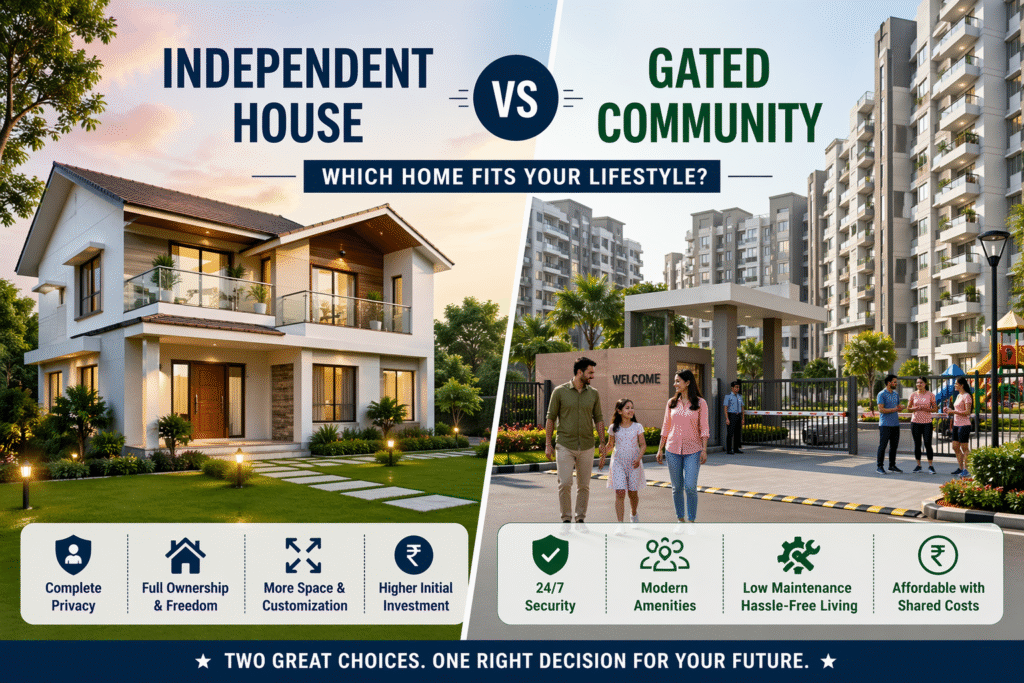
Choosing a home is one of the most important decisions in life. However, with evolving lifestyles and urban development, the choice often comes down to two popular options: independent houses and gated communities. While both offer unique advantages, they also come with certain limitations. Therefore, understanding their differences can help you make a smarter and more satisfying investment.
Understanding Independent Houses
To begin with, an independent house is a standalone property built on its own land. It offers complete ownership, including the building and the plot. Because of this, homeowners enjoy full control over design, renovation, and usage.
Moreover, independent houses provide unmatched privacy. Unlike shared spaces in apartments or communities, there are no common walls or shared facilities. As a result, residents experience a quieter and more personal lifestyle.
However, despite these benefits, independent houses also require significant responsibility. For instance, maintenance, security, and utility management fall entirely on the homeowner. Consequently, this can become both time-consuming and costly over time.
What Are Gated Communities?
On the other hand, gated communities are residential complexes that consist of multiple homes within a secured boundary. These communities are designed to offer convenience, safety, and a sense of shared living.
In addition, gated communities typically come with modern amenities such as parks, gyms, swimming pools, and clubhouses. Therefore, they appeal especially to families and individuals seeking a balanced lifestyle.
Furthermore, maintenance services are usually managed by a dedicated association. As a result, residents can enjoy a hassle-free living experience without worrying about daily upkeep.
Privacy vs. Community Living
When comparing both options, privacy is often a key factor. Independent houses clearly provide greater privacy since there are no shared spaces or close neighbors. For individuals who value solitude, this can be a major advantage.
In contrast, gated communities promote social interaction. For example, residents often participate in events, celebrations, and group activities. Consequently, this fosters a strong sense of belonging and community bonding.
Therefore, the choice between privacy and social engagement depends largely on personal preference and lifestyle.
Security Considerations
Another important aspect to consider is security. Independent houses, although private, may require additional investment in security systems such as CCTV cameras, alarms, and guards. Without these measures, safety can sometimes be a concern.
Conversely, gated communities are designed with security as a priority. Typically, they include 24/7 surveillance, controlled entry points, and professional security personnel. As a result, residents often feel safer, especially families with children and elderly members.
Hence, for those prioritizing security, gated communities tend to have a clear advantage.
Cost and Investment Value
When it comes to cost, independent houses usually involve a higher initial investment. This is because buyers are purchasing both land and construction. Additionally, maintenance costs can add up over time.
However, independent houses often appreciate well in value due to land ownership. Therefore, they can be a strong long-term investment.
In comparison, gated community homes, especially apartments, are generally more affordable initially. Moreover, shared maintenance costs make them easier to manage financially.
That said, while they also appreciate in value, the rate may depend on factors such as location, amenities, and developer reputation. Thus, both options offer investment potential, but in different ways.
Maintenance and Convenience
Maintenance is another area where the difference becomes quite clear. Independent house owners must handle everything themselves, from repairs to landscaping. Consequently, this can require both time and effort.
In contrast, gated communities provide centralized maintenance services. For instance, cleaning, gardening, and repairs are managed collectively. As a result, residents enjoy a more convenient and stress-free lifestyle.
Therefore, for busy professionals or families, gated communities often prove to be a more practical choice.
Lifestyle and Amenities
Lifestyle plays a crucial role in this comparison. Independent houses offer flexibility and freedom. For example, homeowners can customize their property, add extensions, or even redesign spaces as they wish.
However, they may lack access to shared amenities unless developed independently.
On the contrary, gated communities are designed to enhance lifestyle. With facilities like fitness centers, sports courts, and recreational areas, residents can enjoy a well-rounded living experience.
Additionally, these amenities encourage a healthy and active lifestyle. Hence, gated communities often appeal to modern urban dwellers.
Space and Expansion
Independent houses generally offer more space, both indoors and outdoors. This makes them ideal for larger families or those who value open areas.
Furthermore, expansion is easier in independent houses. For instance, adding floors or modifying layouts can be done without much restriction.
In contrast, homes in gated communities may have limited space and stricter regulations. As a result, customization options can be restricted.
Which One Should You Choose?
Ultimately, the decision between an independent house and a gated community depends on your priorities.
If you value privacy, ownership of land, and freedom to customize, then an independent house may be the right choice. On the other hand, if you prefer security, convenience, and access to modern amenities, a gated community might suit you better.
Moreover, factors such as budget, family size, lifestyle, and long-term goals should also influence your decision.
Final Thoughts
In conclusion, both independent houses and gated communities offer distinct advantages. While independent houses provide freedom and privacy, gated communities deliver convenience and security. Therefore, there is no one-size-fits-all answer.
Instead, carefully evaluate your needs and future plans. By doing so, you can choose a home that not only meets your expectations but also enhances your quality of life.
After all, a home is not just a place to live—it’s a space where comfort, happiness, and memories come together.