
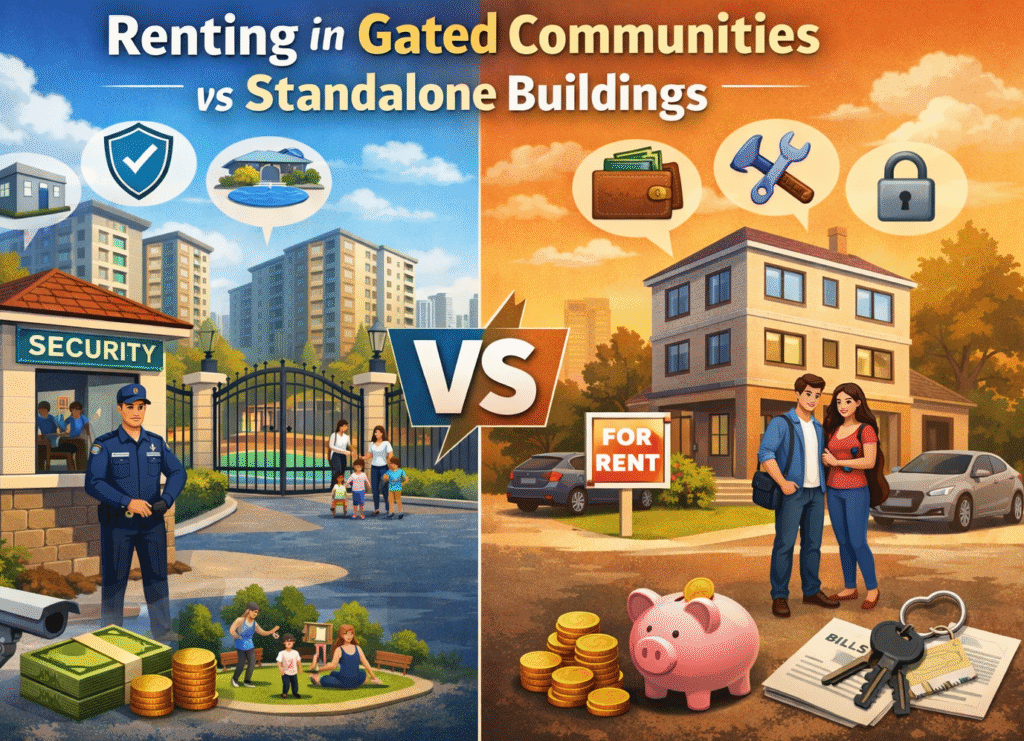
Choosing a rental home is rarely just about the rent amount. Instead, it involves balancing comfort, safety, lifestyle, and long-term value. In many growing cities, renters often find themselves deciding between two popular options: gated communities and standalone buildings. While both offer distinct advantages, they also come with trade-offs. Therefore, understanding the cost-benefit perspective of each can help renters make smarter, more satisfying housing decisions.
Understanding the Two Housing Types
To begin with, gated communities are residential complexes with controlled entry points, shared amenities, and organized management systems. Typically, these communities include features such as security personnel, landscaped parks, clubhouses, and recreational spaces.
On the other hand, standalone buildings are independent residential structures, often owned by a single landlord or family. Although they may lack large shared facilities, they usually offer greater privacy and simpler living arrangements.
Consequently, the decision between the two often depends on how renters value cost, lifestyle, and convenience.
Rental Costs: Upfront and Monthly Differences
First and foremost, rent is the most visible factor. In most cities, gated communities command higher monthly rents compared to standalone buildings. This is largely because renters are not only paying for the apartment but also for the infrastructure surrounding it.
Additionally, gated communities usually include maintenance fees. These charges cover security services, cleaning staff, elevators, lighting, landscaping, and shared amenities. While these features improve quality of life, they also increase monthly expenses.
Conversely, standalone buildings tend to have lower rents and minimal maintenance costs. Since there are fewer shared facilities to manage, renters often pay only for essential services like water, electricity, and basic upkeep. Therefore, for tenants on a strict budget, standalone buildings may appear more financially practical.
However, cost alone does not determine value. Instead, renters must also evaluate what they receive in return for the extra spending.
Safety and Security Considerations
One of the strongest arguments in favor of gated communities is enhanced security. Because entry points are monitored, visitor access is logged, and surveillance systems are common, residents often feel safer.
Moreover, this added sense of protection can be especially appealing for families, individuals living alone, or renters new to a city. In many cases, the presence of guards and cameras reduces risks such as theft or unauthorized entry.
In contrast, standalone buildings generally rely on basic locks or occasional watchmen. While this may suffice in quieter neighborhoods, it may not offer the same level of reassurance as a controlled complex.
Thus, although gated communities cost more, renters may view the added security as a worthwhile investment in peace of mind.
Lifestyle and Amenities: Convenience vs Simplicity
Beyond security, lifestyle differences also play a major role. Gated communities often function like mini-townships. For instance, they may include gyms, jogging tracks, playgrounds, and community halls. Consequently, residents can socialize, exercise, and relax without leaving the premises.
Furthermore, such amenities reduce the need for external memberships or travel, indirectly saving time and money. For working professionals and families with children, this convenience can significantly enhance daily life.
By comparison, standalone buildings rarely offer such facilities. Renters may need to travel for recreation, fitness, or social interaction. While this might seem inconvenient, some tenants actually prefer the simplicity. Without shared amenities, there are fewer rules, less noise from common areas, and often more privacy.
Therefore, the choice here depends on whether renters prioritize community living or independent space.
Flexibility and Rental Negotiation
Another important factor is flexibility. Standalone buildings typically offer more room for negotiation. Since landlords manage the property directly, renters may be able to discuss rent adjustments, maintenance requests, or lease terms more easily.
In contrast, gated communities often follow standardized policies. Maintenance fees, parking rules, visitor regulations, and rental agreements tend to be fixed. While this ensures consistency, it may also reduce negotiation opportunities.
Hence, renters who value personalized arrangements may find standalone buildings more accommodating.
Maintenance and Infrastructure Quality
Infrastructure quality can also influence long-term value. Gated communities are usually planned developments, meaning roads, drainage, elevators, and electrical systems are designed with scale and durability in mind. As a result, residents often experience fewer infrastructure issues.
Additionally, management teams regularly monitor repairs, cleanliness, and utilities. Therefore, maintenance problems are often addressed more quickly.
Standalone buildings, however, depend largely on the owner’s involvement. Some landlords maintain their properties well, while others may delay repairs or upgrades. Consequently, renters may face inconsistent living conditions.
Thus, although gated communities involve higher maintenance fees, they often provide more reliable infrastructure.
Social Environment and Community Interaction
Interestingly, social experience differs greatly between the two options. Gated communities encourage interaction through shared spaces and events. Neighbors meet in parks, children play together, and festivals are celebrated collectively. As a result, renters often develop a stronger sense of belonging.
On the contrary, standalone buildings tend to be quieter and less socially active. For some renters, this means greater independence and fewer disturbances. For others, however, it may lead to isolation, especially in unfamiliar cities.
Therefore, renters should consider whether they prefer community engagement or a more private lifestyle.
Long-Term Value Perspective
Finally, it is helpful to view renting as more than a monthly transaction. While gated communities cost more upfront, they may offer long-term value through security, convenience, and stable infrastructure.
Meanwhile, standalone buildings offer immediate financial savings and flexibility, which can be crucial for students, young professionals, or short-term tenants.
Ultimately, the better option depends on personal priorities. If comfort, safety, and amenities matter most, the additional cost of a gated community may be justified. Conversely, if affordability, independence, and simplicity are key, standalone buildings may provide better value.
Conclusion
In conclusion, renting in gated communities and standalone buildings involves more than comparing rent figures. Instead, it requires evaluating security, lifestyle benefits, infrastructure reliability, and personal preferences.
While gated communities deliver convenience, safety, and social engagement at a higher cost, standalone buildings offer affordability, flexibility, and privacy. Therefore, renters should weigh not only what they pay but also what they gain.
After all, the right home is not simply the cheapest option — it is the one that best supports daily comfort, long-term stability, and personal well-being.