In the modern world, cities are growing rapidly because of increasing population, economic development, and migration. As urban areas expand, people are looking for homes that provide safety, comfort, privacy, and a good quality of life. Consequently, gated communities have become increasingly popular in many cities. A gated community is a residential area surrounded by walls, fences, or controlled entrances, where access is usually monitored by security guards or electronic systems. These communities often provide facilities such as parks, swimming pools, gyms, clubhouses, playgrounds, and private roads. Although gated communities offer several benefits, they have also raised concerns about social segregation. Therefore, it is important to understand how these communities influence relationships between different social and economic groups.
The Growth of Gated Communities
Gated communities have grown because many people want a secure and comfortable living environment. In large cities, concerns about crime, traffic, pollution, and overcrowding have encouraged families to search for more controlled residential spaces. Moreover, developers promote gated communities as complete lifestyle destinations where residents can access housing, recreation, security, and other services within one location.
In addition, these communities often provide modern infrastructure and attractive surroundings. Well-maintained gardens, children’s play areas, walking paths, sports facilities, and community halls make them appealing to families. As a result, people may prefer gated communities over traditional neighborhoods.
However, the popularity of these developments is not based only on physical facilities. People also choose them because they offer a sense of exclusivity and privacy. Residents generally have more control over who enters the community. Consequently, they may feel safer and more comfortable in their daily lives.
Understanding Social Segregation
Social segregation means the separation of different groups within society. This separation can occur because of income, occupation, religion, ethnicity, education, or social status. In cities, social segregation is often visible when wealthy people live in one area while middle- and low-income groups live in completely different neighborhoods.
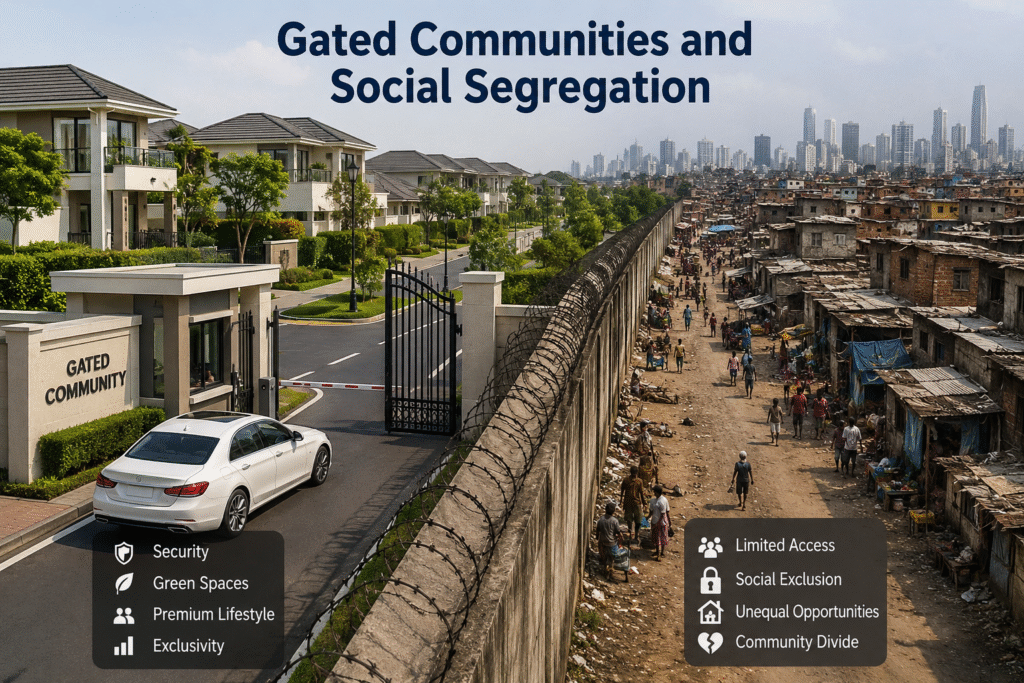
Gated communities can contribute to this separation because they often have restricted access and relatively high housing costs. For example, a high-income residential development may be located close to a lower-income neighborhood. Although the two communities may be geographically close, the residents may have very different lifestyles and access to resources.
Furthermore, walls and security gates create a clear physical boundary. These barriers are primarily intended for protection; nevertheless, they can also symbolize social and economic divisions. Therefore, gated communities can sometimes make existing inequalities more visible.
Economic Differences and Housing
One of the strongest connections between gated communities and social segregation is economic inequality. Gated housing developments often have higher property prices, maintenance charges, and membership fees for recreational facilities. As a result, only people with sufficient financial resources can afford to live there.
On the other hand, people working in and around these communities may earn significantly less. Security guards, cleaners, gardeners, delivery workers, drivers, and domestic workers may regularly enter gated communities but cannot afford to live there. This creates an interesting social contrast. The community depends on workers from different economic backgrounds, yet those workers remain outside the residential community.
Moreover, when wealthy households are concentrated in one location, they may have access to better infrastructure and private services. Meanwhile, nearby low-income communities may struggle with inadequate roads, public transportation, sanitation, or recreational facilities. Consequently, residential separation can reinforce broader patterns of inequality.
Impact on Social Interaction
Social interaction is essential for creating understanding and cooperation among different groups. When people from different backgrounds interact regularly, they can learn about each other’s experiences and develop greater empathy. However, gated communities may reduce these opportunities.
Residents often have private facilities such as parks, gyms, swimming pools, and recreational areas. Therefore, they may not need to use public spaces as frequently as residents of traditional neighborhoods. Similarly, private transportation and controlled entrances can reduce casual interaction with people outside the community.
Furthermore, children growing up in gated communities may spend most of their time with others who have similar economic and social backgrounds. As a result, they may have fewer opportunities to understand different ways of life. Over time, this lack of interaction can contribute to stereotypes and social distance.
Nevertheless, gated communities can also create strong relationships among their own residents. Community celebrations, sports events, cultural programs, and neighborhood activities can encourage friendship and cooperation. Thus, gated communities are not necessarily socially isolated; rather, their social interaction may be concentrated within a particular group.
Security Versus Social Inclusion
Security is one of the most important reasons why people choose gated communities. In many urban areas, residents are concerned about theft, unauthorized entry, traffic accidents, and other safety issues. Therefore, controlled access, CCTV cameras, security guards, and visitor-management systems can provide peace of mind.
However, security measures can sometimes create a conflict between privacy and social inclusion. A community that completely separates itself from its surroundings may become disconnected from the wider city. In contrast, an inclusive neighborhood can maintain reasonable security while still allowing interaction with surrounding communities.
Therefore, the goal should not be to eliminate gated communities completely. Instead, cities should consider how these communities can provide safety without creating unnecessary social barriers.
Gated Communities and Urban Development
Urban planning has an important role in addressing social segregation. If cities are designed in a way that separates people according to income, social divisions may become stronger. Conversely, mixed-income neighborhoods can provide opportunities for people from different backgrounds to live near one another.
Moreover, public spaces can help reduce social distance. Parks, libraries, sports centers, schools, markets, and community halls provide opportunities for interaction. If gated communities are connected to such public spaces, residents can participate in activities beyond their private residential environment.
In addition, better public transportation can connect gated communities with surrounding neighborhoods. This can improve access to employment, education, healthcare, and recreational opportunities. Consequently, physical connectivity can help reduce social isolation.
Developers and residents’ associations can also contribute by organizing activities that involve nearby communities. For example, environmental campaigns, blood donation drives, educational programs, cultural celebrations, and sports competitions can encourage cooperation between different groups.
Are Gated Communities Completely Negative?
Although gated communities can contribute to social segregation, they should not be viewed as completely negative. They provide genuine benefits to many residents, including security, privacy, organized infrastructure, and access to recreational facilities. Moreover, residents often choose them because of practical concerns rather than a deliberate desire to separate themselves from society.
The real concern arises when these communities become symbols of extreme inequality or complete social isolation. Therefore, the focus should be on creating a balance between private residential needs and the wider social needs of the city.
Conclusion
In conclusion, gated communities are an important feature of modern urban development. They provide security, privacy, comfort, and a range of facilities that can improve residents’ quality of life. However, at the same time, their walls, controlled entrances, high costs, and exclusive facilities can contribute to physical and social segregation.
Nevertheless, gated communities do not automatically have to create division. Through thoughtful urban planning, accessible public spaces, mixed-income housing, better transportation, and community-based activities, cities can encourage greater interaction between different social groups. Furthermore, residents and developers can take steps to connect their communities with the neighborhoods around them.
Ultimately, the challenge is to create cities where people can enjoy safety and privacy without losing their connection to wider society. A truly successful city should not only provide comfortable homes but also encourage interaction, understanding, and equality. Therefore, gated communities should be designed not as isolated islands, but as responsible parts of a larger and more inclusive urban community.