
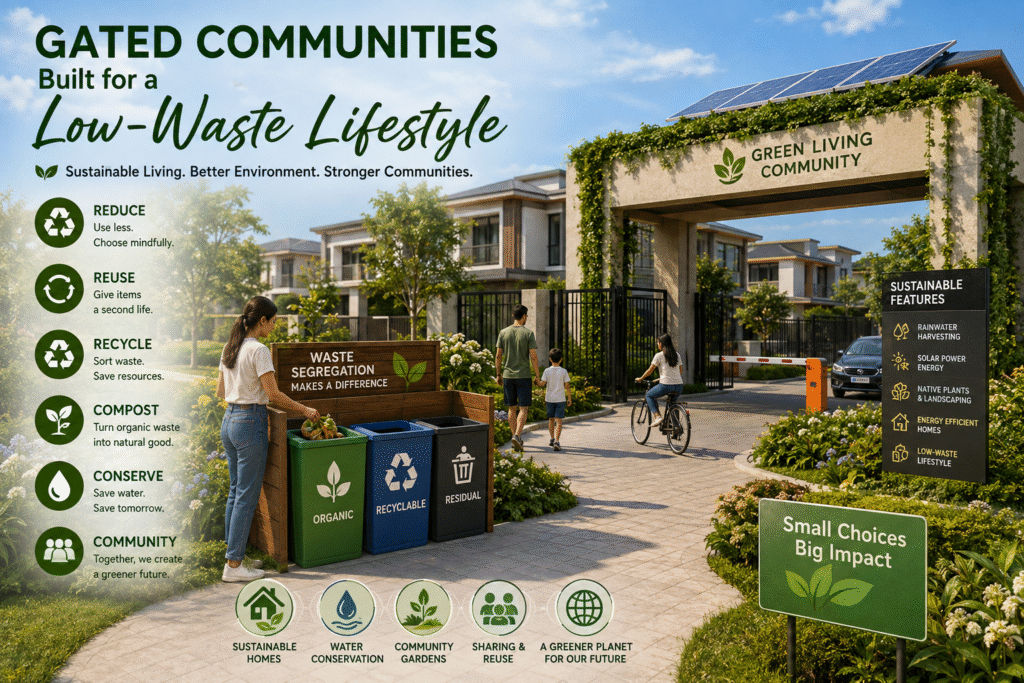
As environmental concerns continue to grow, homeowners are becoming more conscious of how their everyday choices affect the planet. Consequently, modern residential communities are beginning to move beyond traditional ideas of comfort, security, and luxury. Today, many homebuyers are looking for communities that also support sustainable and responsible living. Gated communities built for a low-waste lifestyle are emerging as an attractive solution for people who want a cleaner, greener, and more efficient way to live.
A low-waste lifestyle does not mean eliminating waste completely. Instead, it focuses on reducing unnecessary consumption, reusing resources, recycling materials, and making smarter choices. When these principles are incorporated into the design of a gated community, residents can enjoy sustainability without sacrificing convenience.
What Is a Low-Waste Gated Community?
A low-waste gated community is a residential development designed to reduce the amount of waste produced by households and common areas. In addition, it encourages residents to make environmentally responsible choices through thoughtful infrastructure and community facilities.
For example, such communities may provide separate waste collection areas, composting facilities, recycling stations, rainwater harvesting systems, energy-efficient homes, and landscaped spaces that require fewer resources. Therefore, sustainability becomes part of everyday life rather than an occasional activity.
Moreover, community-wide planning makes sustainable living easier. Instead of every homeowner having to create an individual waste-reduction system, residents can benefit from shared facilities and organized programs.
Smart Waste Segregation at the Source
One of the most effective ways to reduce waste is to separate it at the source. Consequently, low-waste gated communities can provide designated bins for organic waste, recyclable materials, and non-recyclable waste.
This simple system can significantly improve waste management. Food scraps and garden waste, for instance, can be collected separately and converted into compost. Meanwhile, paper, glass, metal, and certain plastics can be directed toward recycling facilities.
Furthermore, clearly labeled collection points can educate residents about proper waste segregation. As a result, children and adults can gradually develop responsible waste-management habits.
Community Composting Facilities
Food and garden waste make up a significant portion of household waste. However, much of this material can be reused instead of being sent to landfills.
Therefore, gated communities can establish shared composting facilities where residents deposit suitable organic waste. The resulting compost can then be used in community gardens, landscaped areas, and green spaces.
This approach creates a useful cycle. Residents provide organic waste, the community converts it into compost, and the compost supports plant growth. Thus, something that would normally become waste becomes a valuable resource.
Reducing Single-Use Plastics
Another important feature of low-waste communities is reducing dependence on single-use plastics. For example, community events can encourage reusable plates, cups, and food containers instead of disposable alternatives.
Similarly, water refill stations can reduce the need for plastic bottles. Residents can carry reusable bottles while walking, exercising, or using community facilities.
In addition, community management can minimize plastic packaging when purchasing cleaning products, gardening supplies, and maintenance materials. Although these changes may appear small, they can make a considerable difference when implemented across hundreds of households.
Sustainable Construction and Home Design
Low-waste living can begin even before residents move into their homes. Modern gated communities can incorporate sustainable construction materials, efficient building techniques, and durable fixtures.
For instance, homes can use recycled or locally sourced materials where appropriate. Furthermore, durable flooring, fittings, and finishes can reduce the frequency of replacements and renovations.
Energy-efficient windows, insulation, LED lighting, and efficient appliances can also lower household resource consumption. Consequently, homeowners may reduce both their environmental impact and long-term utility expenses.
Rainwater Harvesting and Water Conservation
Waste reduction is not limited to solid waste. Water is another valuable resource that communities must manage responsibly.
Therefore, gated communities can incorporate rainwater harvesting systems to collect and store rainwater for suitable non-potable uses. This water can potentially support landscaping, gardening, and other approved purposes.
Additionally, low-flow taps, efficient plumbing fixtures, and smart irrigation systems can reduce unnecessary water consumption. As a result, communities can use water more efficiently while helping residents develop conservation habits.
Green Spaces That Support Sustainability
Green spaces are an essential part of attractive residential communities. However, landscaping can sometimes require significant amounts of water, fertilizer, and maintenance.
For this reason, low-waste communities can choose native and climate-appropriate plants that require fewer resources. Furthermore, organic compost generated within the community can support gardens and landscaped areas.
Community gardens can also encourage residents to grow vegetables, herbs, and flowers. Besides providing greenery, these spaces can strengthen social connections and teach children where food comes from.
Encouraging Reuse and Sharing
Low-waste living also means thinking carefully before buying something new. Consequently, gated communities can create spaces or digital platforms where residents exchange, donate, or reuse household items.
For example, families can share books, gardening equipment, children’s toys, sports equipment, or other useful items. A community-level exchange system can prevent perfectly usable products from becoming waste.
Moreover, shared facilities can reduce the need for every household to purchase items that are used only occasionally. In this way, residents can save money while reducing unnecessary consumption.
Technology Can Make Waste Reduction Easier
Technology can further support sustainable living. Smart waste-management systems, for example, can help community managers monitor collection requirements and identify areas where waste is increasing.
Likewise, mobile applications can provide residents with information about recycling schedules, community composting programs, donation drives, and sustainability initiatives.
Smart irrigation systems can also adjust watering based on weather and soil conditions. Similarly, energy-monitoring systems can help homeowners understand their consumption patterns. Therefore, technology can turn sustainability into a practical and measurable part of daily life.
Building a Community Culture Around Sustainability
Infrastructure alone cannot create a low-waste lifestyle. Residents must also participate. For this reason, community associations can organize recycling drives, composting workshops, tree-planting activities, and sustainability awareness programs.
Children can participate in environmental activities as well. Consequently, sustainable habits can become part of family life and continue across generations.
Furthermore, friendly community challenges can motivate residents to reduce waste. For example, neighborhoods might organize campaigns focused on reducing food waste or increasing recycling participation. Such initiatives can make sustainability engaging rather than restrictive.
The Long-Term Benefits of Low-Waste Living
A low-waste gated community offers benefits that extend beyond environmental protection. First, better waste management can create cleaner and more attractive surroundings. Second, resource-efficient infrastructure can potentially reduce operating and household expenses.
Additionally, sustainable communities can appeal to environmentally conscious homebuyers. As sustainability becomes increasingly important in real estate decisions, properties with thoughtful green features may gain greater appeal.
Most importantly, these communities can help residents understand that comfortable living and responsible living do not have to be opposites.
Conclusion
Ultimately, gated communities built for a low-waste lifestyle represent a more thoughtful approach to modern residential development. Through waste segregation, composting, recycling, sustainable construction, water conservation, smart technology, and community participation, these developments can reduce environmental impact while maintaining comfort and convenience.
Moreover, the greatest advantage is that sustainability becomes part of everyday life. Residents do not have to completely change their routines; instead, the community itself makes responsible choices easier.
As a result, low-waste gated communities could play an important role in shaping the future of residential living. By combining modern amenities with environmental responsibility, they offer homeowners an opportunity to enjoy a cleaner, healthier, and more sustainable lifestyle—one practical choice at a time.