Once upon a time, urban freedom was measured in square feet—large houses, private gardens, and quiet streets away from the crowd. However, cities have slowly but decisively rewritten that definition. Today, freedom in urban life is no longer about how much land you own; instead, it is about how easily you can live, move, connect, and choose.
As a result, apartments have emerged not as compromises, but as powerful symbols of modern independence. In fact, they reflect a lifestyle that prioritizes flexibility over permanence, community over isolation, and time over territory. As cities grow denser and lives grow faster, apartments are increasingly becoming the truest expression of urban freedom.
Freedom from Long Commutes
To begin with, one of the most immediate ways apartments offer freedom is through location. Most modern apartment developments are strategically built near business districts, transit hubs, schools, hospitals, and entertainment zones. Consequently, living in an apartment often means living closer to where life actually happens.
Moreover, this proximity significantly reduces the daily burden of long commutes. Less time spent in traffic translates into more time for rest, creativity, relationships, and personal growth. In today’s cities, freedom is closely tied to time—and apartments help residents reclaim it.
Ultimately, in a world that never slows down, choosing an apartment becomes a conscious decision to prioritize living over commuting.
Freedom from Maintenance Burdens
Equally important, apartments offer freedom from the constant responsibilities of traditional homeownership. Independent homes often demand continuous attention—repairs, landscaping, security, and unpredictable expenses. Apartments, by contrast, remove much of this weight.
With professional maintenance teams, security services, and managed facilities, residents are freed from day-to-day worries. As a result, this freedom is not only financial but also mental. People can focus on careers, passions, family, or travel without the stress of managing every detail of a home.
In essence, urban freedom today is about living lightly—and apartments make that lifestyle achievable.
Freedom to Move, Adapt, and Evolve
Furthermore, cities are dynamic, and modern lives are rarely linear. Apartments naturally support a lifestyle that embraces change. Whether someone is switching jobs, relocating within the city, starting a business, or entering a new phase of life, apartment living allows for smooth transitions.
For instance, young professionals value mobility, families appreciate scalable spaces, and retirees prefer low-maintenance living. In all cases, apartments offer flexibility that traditional homes often cannot. Leasing options, resale demand, and urban desirability make apartments adaptable to evolving needs.
Therefore, in a world where stability no longer means staying still, apartments offer freedom through adaptability.
Freedom Through Shared Amenities
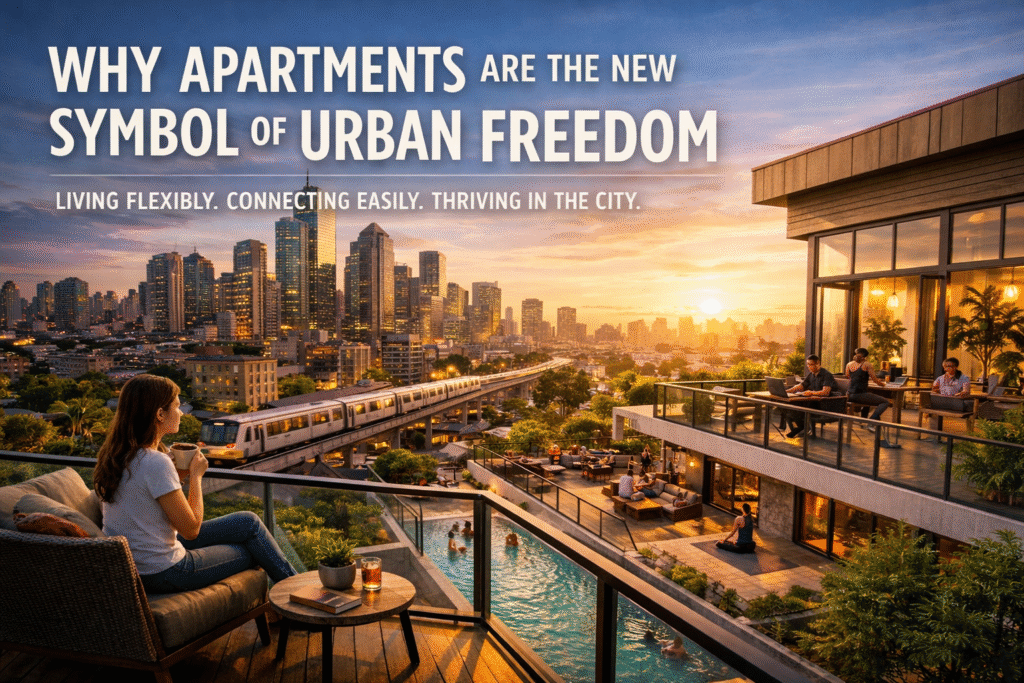
In addition, modern apartments are no longer just places to sleep. Instead, they function as complete lifestyle ecosystems. Gyms, co-working spaces, rooftop gardens, swimming pools, children’s play areas, and community halls are now common features.
Because of this, residents gain access to experiences that would otherwise be expensive or impractical to maintain individually. Rather than owning everything, apartment living emphasizes access over ownership—a defining principle of contemporary urban freedom.
Thus, this shift reflects a larger cultural change: freedom today is about having choices, not accumulating possessions.
Freedom from Social Isolation
At the same time, urban life can be paradoxically lonely. While cities are crowded, meaningful connection is often missing. Apartments counter this reality by creating built-in communities.
Shared spaces encourage interaction, whether through casual conversations, festival celebrations, or community events. Consequently, neighbors often become friends, support systems, or simply familiar faces. Children find playmates nearby, and adults find a sense of belonging without effort.
In truth, freedom is not isolation—it is connection without pressure. Apartments strike that balance naturally.
Freedom for Financial Choice
Similarly, apartments often provide a more accessible and practical entry point into urban real estate. Compared to independent homes, they generally require lower upfront investment and offer more predictable monthly expenses.
As a result, residents can allocate their finances toward travel, education, entrepreneurship, or life experiences rather than locking all resources into property maintenance. In an era where financial freedom is closely linked to personal freedom, apartments offer balance and control.
Simply put, they allow people to live well in cities without being financially overwhelmed by them.
Freedom for Sustainable Living
Meanwhile, sustainability has become a vital part of modern freedom—the freedom to live responsibly without sacrificing comfort. Apartments naturally support eco-conscious living through shared infrastructure and efficient land use.
For example, centralized utilities, rainwater harvesting, waste management systems, and energy-efficient designs are easier to implement in apartment communities. Consequently, residents enjoy a reduced environmental footprint without managing sustainability alone.
In this way, urban freedom now includes the freedom to live ethically—and apartments support that choice.
Freedom Across Life Stages
Notably, apartments are no longer tied to a single age group or life phase. Instead, they serve people across generations. Young adults seek convenience, families value safety and community, while seniors appreciate accessibility and reduced maintenance.
Because apartments adapt to changing needs, they function as long-term solutions rather than temporary arrangements. Therefore, freedom lies in choosing a home that evolves alongside you—and apartments do exactly that.
Redefining the Meaning of Home
Ultimately, the idea of home itself has changed. It is no longer only about permanence or ownership; rather, it is about alignment with lifestyle, values, and priorities.
Apartments align seamlessly with urban values—efficiency, diversity, connectivity, and intentional living. They reflect a generation that values experiences over excess, connection over isolation, and freedom over convention.
In this sense, apartments are not merely homes—they are lifestyle statements.
Conclusion: Urban Freedom, Reimagined
In conclusion, apartments have evolved from simple housing solutions into powerful representations of modern urban freedom. They offer freedom of time, movement, financial choice, community, sustainability, and personal growth—all within the heartbeat of the city.
As urban life continues to transform, apartments remain at the center of this evolution. They prove that freedom is not about escaping the city, but about living fully within it.
Today, apartments do not limit freedom. Instead, they define it.