
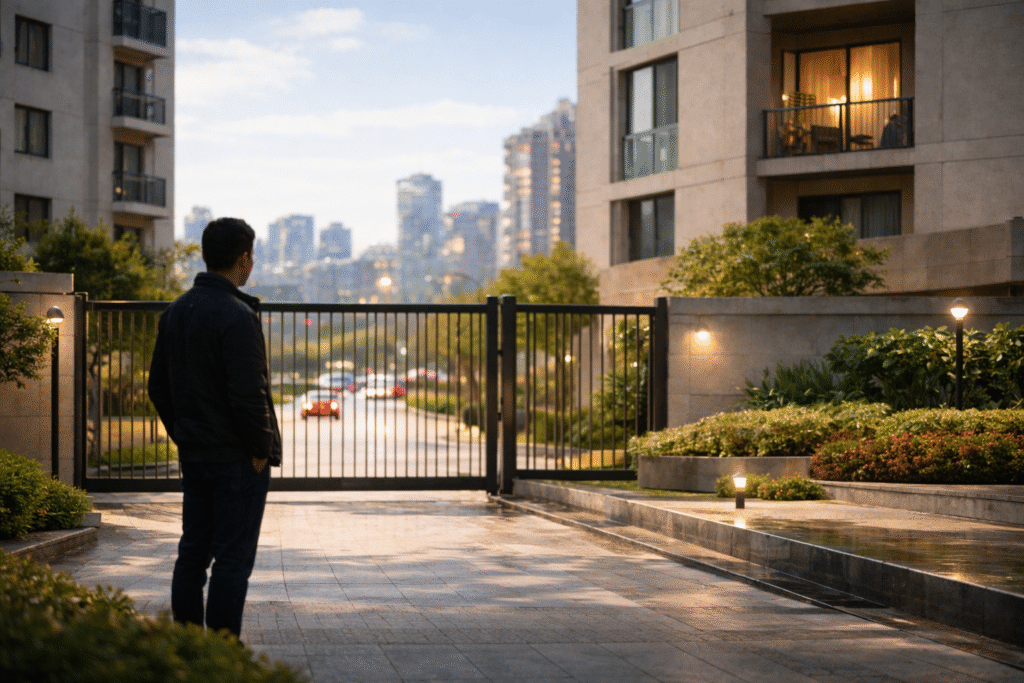
At first glance, renting in a gated community seems like a purely practical decision. After all, people often point to security, amenities, or convenience as the main reasons. However, beneath these visible factors lies a deeper layer—one shaped by psychology, emotion, and identity. In reality, the choice to rent inside gates is rarely just about a house; instead, it is about how people want to feel, live, and be perceived.
The Need for Safety and Predictability
To begin with, safety plays a powerful role in human decision-making. Psychologically, gated communities appeal to our basic need for protection and predictability. When boundaries are clearly defined—walls, gates, guards—the mind often interprets them as control over chaos.
Moreover, for renters who may already feel a lack of permanence, the controlled environment of a gated community compensates for that uncertainty. Even if the lease is temporary, the surroundings feel stable. As a result, anxiety about the outside world—traffic, noise, crime, or unpredictability—tends to soften once one crosses the gate.
In addition, parents, single professionals, and elderly renters often experience a subtle sense of relief knowing that their living space is monitored. While this does not eliminate fear entirely, it reduces mental load, allowing residents to focus on daily life rather than constant vigilance.
Status, Identity, and Social Belonging
Beyond safety, status quietly influences the decision to rent in gated communities. Although renters may not openly admit it, living behind gates often signals success, aspiration, or upward mobility. Psychologically, this matters because humans are deeply social beings who seek belonging and recognition.
Furthermore, a gated address can become part of personal identity. It shapes how renters describe their lifestyle to others—and sometimes even to themselves. Consequently, renting in such spaces offers a sense of “arriving,” even if ownership is not yet part of the picture.
At the same time, gated communities create a shared social narrative. Neighbors often belong to similar income brackets, professions, or life stages. Because of this, renters may feel understood and accepted more easily, which strengthens emotional comfort and reduces feelings of social mismatch.
The Illusion of Control in a Rented Space
Interestingly, renting usually implies limited control. Tenants cannot modify walls, redesign layouts, or make permanent changes. However, gated communities psychologically soften this limitation.
On one hand, the presence of landscaped gardens, gyms, clubhouses, and walking tracks gives renters access to “ownership-like” privileges. On the other hand, maintenance responsibilities are outsourced. As a result, renters enjoy the benefits of a high-quality environment without the stress of upkeep.
This creates an illusion of control—where residents feel they are living well by choice rather than compromise. Consequently, renting no longer feels like a temporary setback but a conscious lifestyle decision.
Emotional Comfort and the Design of Space
Another important psychological factor lies in design. Gated communities are often planned with symmetry, greenery, and order. These visual cues subtly influence emotional well-being.
For instance, wide internal roads, uniform architecture, and landscaped open spaces communicate calm and organization. In contrast to chaotic urban streets, such environments reduce sensory overload. Therefore, renters often experience lower stress levels simply by coming home.
Additionally, shared amenities encourage routine. Morning walks, evening gym sessions, or weekend gatherings create rhythm. Over time, these patterns foster emotional attachment—not necessarily to the property, but to the lifestyle it enables.
Privacy Versus Isolation
However, the psychology of renting in gated communities is not entirely positive. While gates promise privacy, they can also lead to emotional distance.
On one side, renters appreciate the separation from city noise and unsolicited interactions. On the other side, this separation can create isolation. Casual street life—vendors, spontaneous conversations, neighborhood familiarity—often disappears behind walls.
As a result, some renters experience a quiet loneliness, especially those new to a city. Although surrounded by people, they may still feel disconnected. This highlights a psychological paradox: gated communities offer social proximity without guaranteed emotional connection.
Temporary Living, Permanent Feelings
Renting is often associated with impermanence. Yet, gated communities challenge this idea. Because these spaces are designed for long-term comfort, renters may begin to emotionally settle in—even when they know the arrangement is temporary.
Consequently, leaving can feel harder than expected. The mind forms attachments not just to the apartment, but to routines, neighbors, and the sense of security. This emotional contradiction—knowing you must leave while feeling like you belong—can be psychologically complex.
Moreover, renters sometimes delay other life decisions because the current setup feels “good enough.” While this comfort is not inherently negative, it can subtly influence long-term goals around ownership, relocation, or lifestyle change.
Community Rules and Psychological Compliance
Another overlooked aspect is the psychological impact of rules. Gated communities often come with regulations—quiet hours, visitor policies, pet rules, and common-area norms.
Interestingly, many renters find comfort in these boundaries. Clear rules reduce ambiguity and conflict, which the human brain generally prefers. However, excessive regulation can also feel restrictive, especially for individuals who value freedom and spontaneity.
Thus, renters subconsciously weigh structure against autonomy. When the balance feels right, the community feels safe. When it doesn’t, the same gates that once felt protective may start to feel confining.
Aspirations, Not Just Accommodation
Ultimately, renting in a gated community is less about shelter and more about aspiration. It reflects how renters imagine their future selves—organized, secure, and successful.
In many cases, these communities serve as psychological stepping stones. They allow renters to experience a lifestyle they hope to maintain or upgrade later. As a result, renting becomes part of a personal narrative of growth rather than a sign of delay.
Conclusion: More Than Just a Rental Choice
In conclusion, the psychology of renting in gated communities goes far beyond practical benefits. It is shaped by the need for safety, belonging, control, and emotional comfort. While gates may physically separate residents from the outside world, they also create an internal space where renters negotiate identity, aspiration, and peace of mind.
Therefore, when someone chooses to rent behind gates, they are not just selecting an apartment. Instead, they are choosing a feeling—a sense of order in a noisy world, a pause from uncertainty, and a lifestyle that feels intentional, even if temporary.