
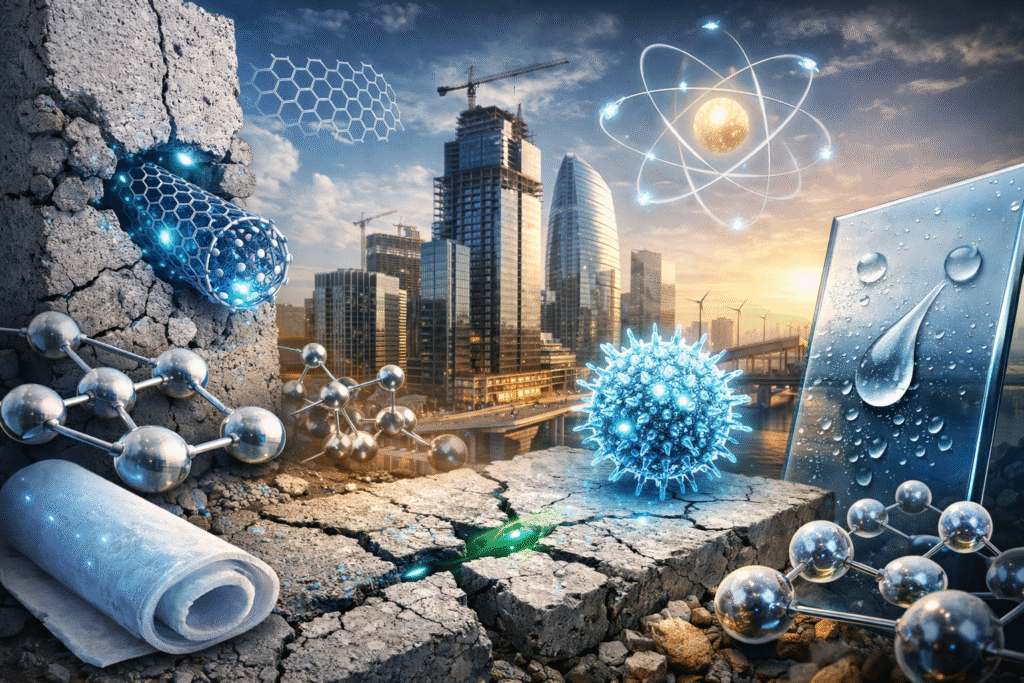
In modern construction, strength no longer comes only from what we can see. Today, some of the most powerful innovations exist at a scale invisible to the human eye. Nanotechnology, the science of manipulating materials at the atomic and molecular level, is quietly transforming how buildings are designed, built, and maintained. Although tiny in size, nanomaterials are delivering massive improvements in durability, sustainability, and performance.
As construction faces rising demands for efficiency, resilience, and environmental responsibility, nanotechnology is emerging as a game-changing solution. This blog explores how this “invisible strength” is reshaping modern construction materials and redefining the future of the built environment.
Understanding Nanotechnology in Construction
To begin with, nanotechnology works at the nanoscale, typically between 1 and 100 nanometers. At this scale, materials behave differently. Their physical, chemical, and mechanical properties improve in ways not possible at larger sizes.
In construction, nanotechnology is not about replacing traditional materials. Instead, it enhances them. By integrating nanoparticles into concrete, steel, glass, coatings, and composites, engineers can improve strength, reduce weight, increase resistance, and extend service life. As a result, structures become smarter, stronger, and more efficient without drastic changes in appearance or construction methods.
Nano-Enhanced Concrete: Stronger From the Inside
Concrete remains the backbone of modern construction. However, it has long struggled with cracking, permeability, and long-term durability. This is where nanotechnology makes a significant impact.
For instance, nanoparticles such as nano-silica fill microscopic pores within concrete. As a result, the material becomes denser and stronger. This reduces water penetration, limits crack formation, and improves resistance to chemical attacks. In addition, nano-silica accelerates cement hydration, leading to higher early strength.
Moreover, carbon nanotubes and graphene nanoparticles enhance tensile strength and flexibility. Consequently, concrete becomes less brittle and more resistant to stress. Although these improvements occur at an invisible level, their effects are clearly visible in longer-lasting structures and reduced maintenance costs.
Smarter Steel Through Nanotechnology
Steel plays a critical role in construction due to its high strength and flexibility. However, corrosion remains one of its biggest challenges. Nanotechnology offers effective solutions to this persistent problem.
By altering the microstructure of steel at the nanoscale, manufacturers can significantly improve corrosion resistance. For example, nano-coatings act as protective barriers that prevent moisture and oxygen from reaching the metal surface. This dramatically slows down rust formation.
Furthermore, nano-engineered steel can achieve higher strength with less material. As a result, structures become lighter without compromising safety. This not only reduces material consumption but also lowers transportation and installation costs, making construction more efficient overall.
Self-Cleaning and Protective Nano-Coatings
Another remarkable application of nanotechnology lies in surface coatings. These coatings may appear ordinary, yet they deliver extraordinary performance.
For example, nano-coatings inspired by the lotus leaf create self-cleaning surfaces. When rain falls, water droplets roll off, carrying dirt and dust along with them. Consequently, building facades remain clean with minimal maintenance.
In addition, nano-coatings provide UV protection, thermal insulation, and resistance to pollution. They help prevent surface degradation caused by harsh environmental conditions. Over time, this extends the life of buildings and preserves their appearance.
As urban pollution increases, these protective coatings are becoming increasingly valuable for both residential and commercial structures.
Energy-Efficient Glass and Insulation Materials
Energy efficiency has become a top priority in modern construction. Nanotechnology is playing a vital role in reducing energy consumption through advanced glass and insulation materials.
Nano-coated glass can regulate heat transfer by reflecting infrared radiation while allowing natural light to pass through. As a result, indoor spaces stay cooler in summer and warmer in winter. This reduces the need for artificial heating and cooling, leading to lower energy bills.
Similarly, nano-insulation materials offer superior thermal performance with thinner layers. Aerogels, for instance, are nano-structured materials known for their exceptional insulating properties. Despite being lightweight and thin, they provide high thermal resistance, making them ideal for space-constrained designs.
Self-Healing Materials: A New Era of Durability
One of the most exciting developments in nanotechnology is the emergence of self-healing construction materials. These materials can repair micro-cracks automatically before they become serious structural problems.
In nano-engineered concrete, capsules containing healing agents break open when cracks form. These agents then react with moisture or air, filling the cracks and restoring strength. As a result, structures require fewer repairs and last significantly longer.
This innovation is particularly valuable for bridges, tunnels, and high-rise buildings, where maintenance can be costly and disruptive. Over time, self-healing materials can dramatically reduce lifecycle costs and improve safety.
Sustainability Benefits of Nanotechnology
Beyond performance improvements, nanotechnology supports sustainable construction practices. Stronger materials mean less raw material usage. Longer-lasting structures mean fewer repairs and replacements. Together, these factors reduce waste and environmental impact.
Additionally, nano-enhanced materials often improve energy efficiency, which lowers carbon emissions throughout a building’s lifespan. Some nanomaterials even help capture pollutants or reduce air pollution, contributing to healthier urban environments.
Therefore, nanotechnology aligns closely with global sustainability goals and green building standards.
Challenges and Considerations
Despite its advantages, nanotechnology in construction is not without challenges. High production costs, limited large-scale testing, and concerns about long-term environmental impact still exist. Moreover, industry standards and regulations are still evolving.
However, as research advances and adoption increases, costs are expected to decrease. With proper guidelines and responsible use, nanotechnology can be safely and effectively integrated into mainstream construction.
The Future of Invisible Strength
Looking ahead, nanotechnology will continue to redefine what construction materials can achieve. From smarter infrastructure to resilient cities, the potential is enormous. While these innovations may remain invisible to the eye, their impact will be felt for decades.
In conclusion, the strength of modern construction is no longer measured only in thickness or weight. Instead, it lies in intelligent material design at the smallest scale. Nanotechnology proves that sometimes, the strongest foundations are the ones we cannot see.