
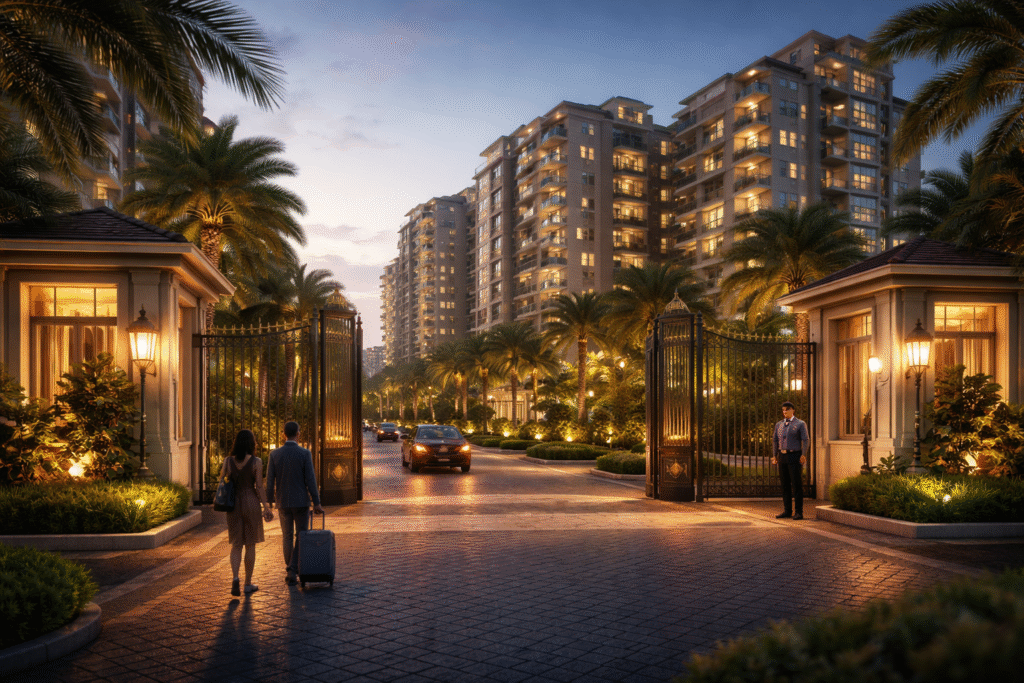
In cities that never seem to slow down, the idea of living behind gates has quietly become mainstream. Once considered a luxury reserved for homeowners, gated communities are now increasingly populated by tenants. As a result, renting inside gated complexes raises an important question: is this choice driven by safety, social status, or simply everyday convenience?
While the answer may differ from person to person, the growing popularity of rented homes within gated communities suggests a deeper shift in how urban dwellers define comfort and security.
The Rise of Gated Living for Renters
Traditionally, gated communities symbolized permanence and ownership. However, over time, changing work cultures, frequent relocations, and flexible lifestyles have altered housing priorities. Consequently, many renters now seek the same benefits once reserved for property owners.
Moreover, rapid urbanization has blurred the line between aspiration and practicality. As cities expand vertically, gated apartment complexes offer an all-in-one solution—housing, amenities, and perceived safety—without the long-term commitment of buying a home. Therefore, renting behind gates no longer feels like a compromise; instead, it feels like an upgrade.
Safety: The Strongest Selling Point
First and foremost, safety remains the most cited reason for choosing gated living. With controlled entry points, security personnel, CCTV surveillance, and restricted visitor access, gated communities promise peace of mind. For renters, especially families, working professionals, and elderly residents, this sense of protection often outweighs other considerations.
Furthermore, the psychological comfort of knowing that children can play within enclosed premises or that late-night returns feel less intimidating cannot be underestimated. Even if actual crime rates vary, the perception of safety itself adds immense value. As a result, many renters willingly pay a premium for this assurance.
At the same time, it is worth noting that gates do not eliminate all risks. However, they do reduce unpredictability. In an increasingly uncertain urban environment, that reduction alone feels like a luxury.
Status: An Unspoken but Powerful Factor
While safety is openly discussed, status often operates quietly in the background. Living in a gated community carries a certain social signal—of success, stability, and upward mobility. Even for renters, the address itself can influence how they are perceived by peers, relatives, and colleagues.
Additionally, gated communities are frequently associated with better infrastructure, cleaner surroundings, and organized living. Over time, these associations translate into prestige. For young professionals or nuclear families, renting in such spaces offers access to a lifestyle they may not yet want to invest in permanently.
However, this raises an interesting contradiction. If status is tied to ownership, does renting dilute that image? In reality, modern urban culture has softened these distinctions. Today, experience matters more than ownership. Therefore, renting behind gates still delivers the social capital many seek.
Convenience: The Quiet Game-Changer
Beyond safety and status, convenience may be the most underrated reason renters choose gated communities. In fact, for many, it becomes the deciding factor.
To begin with, most gated complexes offer amenities such as gyms, parks, walking tracks, power backup, parking, maintenance services, and sometimes even grocery stores or daycare centers. As a result, daily life becomes more efficient. Time spent managing household logistics is significantly reduced.
Moreover, landlords and resident associations usually handle maintenance issues, security coordination, and common area upkeep. For renters juggling demanding jobs or frequent travel, this hands-off living is invaluable. Instead of coordinating with multiple service providers, residents rely on a centralized system.
In other words, gated living simplifies life. And in a world where time is increasingly scarce, simplicity often outweighs ideology.
Community Without Obligation
Another compelling aspect of gated rental living is the balance between community and privacy. On one hand, shared spaces encourage interaction—festivals, fitness groups, and casual conversations. On the other hand, renters retain the freedom to disengage without social pressure.
Unlike traditional neighborhoods where relationships are deeply rooted, gated communities allow for lighter, more flexible connections. This suits renters who value social access without emotional or cultural obligations. Consequently, the environment feels inclusive but not intrusive.
That said, some critics argue that gated living creates social bubbles. While this concern is valid, renters often view these bubbles as temporary sanctuaries rather than permanent separations from society.
The Cost of Living Behind Gates
Naturally, convenience and security come at a price. Rents within gated communities are typically higher than comparable standalone buildings. Additionally, maintenance charges may be indirectly passed on to tenants.
However, many renters justify the cost by calculating value rather than price. When security, amenities, and maintenance are factored in, the premium feels reasonable. Furthermore, the absence of long-term financial risk makes renting an attractive middle ground between aspiration and affordability.
Still, for budget-conscious renters, gated living may feel excessive. In such cases, the choice becomes a personal negotiation between comfort and cost.
Safety, Status, or Convenience—What Really Wins?
Ultimately, the appeal of living behind gates on rent lies not in a single factor but in their combination. Safety draws people in, status reassures them, and convenience convinces them to stay.
More importantly, gated rental living reflects a broader shift in urban values. People no longer measure success solely by ownership. Instead, they prioritize quality of life, flexibility, and mental peace. Renting behind gates aligns perfectly with this mindset.
In conclusion, whether it is about feeling secure, projecting a certain image, or simply making daily life easier, gated communities offer renters a carefully curated living experience. And as cities continue to evolve, this model is likely to grow—not as a symbol of excess, but as a response to modern urban needs.