
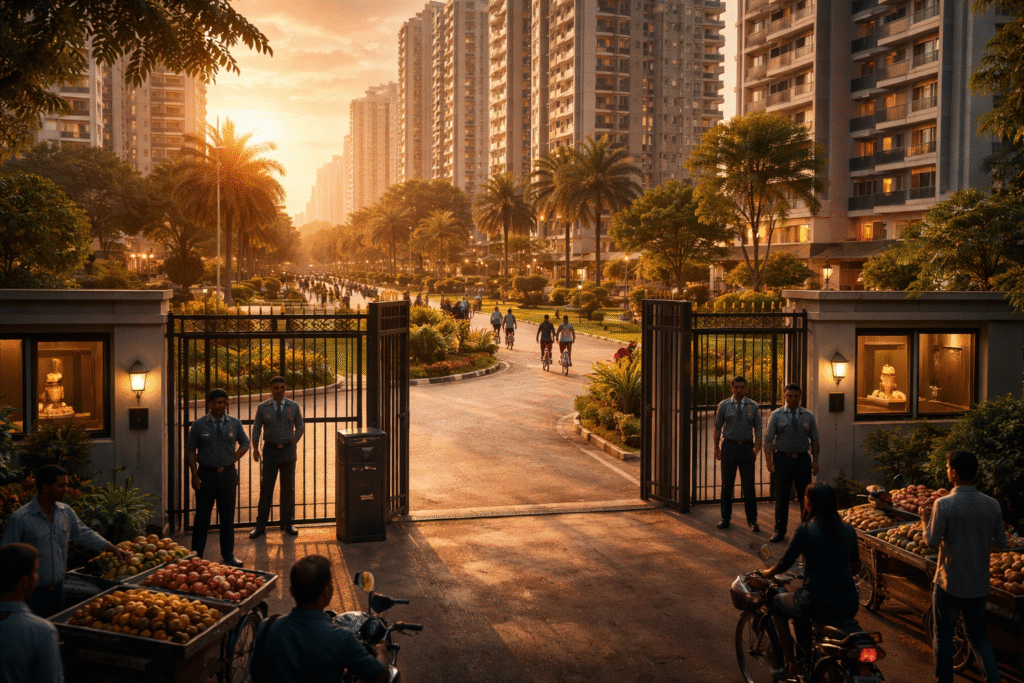
Cities are not just collections of buildings; rather, they are reflections of social structure. Where people live often signals their access to opportunity, security, and mobility. In recent years, gated communities have become symbols of safety and aspiration. However, beyond their walls lies an important question: who truly gets to live behind the gates? The answer reveals how class, income, and access continue to shape urban life.
The Rise of Gated Living
To begin with, gated communities were originally designed to provide exclusivity and protection. Developers marketed them as peaceful sanctuaries away from crowded streets and urban stress. Consequently, they quickly attracted upper-income homeowners seeking privacy and controlled environments.
Over time, however, the model expanded. As cities grew denser and concerns about security increased, developers began offering rental options within gated complexes. At first glance, this shift seemed to democratize access. Renters who could not afford to buy property could still experience the benefits of enclosed living. Nevertheless, affordability remains only part of the story.
Rent Does Not Always Mean Access
Although renting may appear to open doors, entry into gated communities is rarely equal. In fact, rental prices in these spaces are often significantly higher than in open neighborhoods. Therefore, only a narrow segment of renters—typically professionals, expatriates, or dual-income families—can realistically afford them.
Moreover, financial qualification is not the only barrier. Many gated communities enforce strict screening processes. Prospective tenants may need employment verification, background checks, or long-term lease commitments. As a result, informal workers, migrants, and lower-income families often find themselves excluded even if they can manage the rent.
Thus, while renting suggests flexibility, access remains filtered through economic stability and social perception.
Class Signals Beyond Income
In addition to cost, gated communities often reflect deeper class expectations. For instance, residents are expected to maintain certain lifestyles—regular maintenance, adherence to community rules, and participation in shared costs. These requirements subtly reinforce a culture of middle- and upper-class norms.
Furthermore, amenities such as landscaped gardens, clubhouses, gyms, and private parking signal not just comfort but status. Living within these gates communicates belonging to a certain social tier. Consequently, the walls function as both physical and symbolic markers separating those inside from those outside.
Even renters who enter these spaces may feel pressure to conform to the community’s expectations. Therefore, access is not merely about paying rent; it also involves fitting into the social environment behind the gates.
Security or Segregation?
Supporters of gated communities argue that they enhance safety and organization. Indeed, controlled entry points, surveillance systems, and private maintenance often provide residents with a sense of reassurance. Parents may feel comfortable letting children play outside, and elderly residents may appreciate the quieter surroundings.
However, critics contend that gated living deepens urban segregation. By concentrating resources within enclosed zones, cities risk fragmenting into pockets of privilege and neglect. Public infrastructure outside the gates may receive less attention, while services inside become privatized.
As a result, the very features that create comfort for some may reinforce inequality for others. When security becomes a commodity tied to income, the city’s social fabric can weaken.
Renters and the Illusion of Mobility
For many renters, moving into a gated community represents upward mobility. It signals progress—perhaps a better job, a safer environment, or improved living conditions. Yet this sense of advancement can be fragile.
Unlike homeowners, renters remain subject to rising rents, lease changes, and market fluctuations. Consequently, their access to gated living may be temporary. A job loss or rent increase could quickly push them back into less secure housing.
Therefore, while gated rentals may offer short-term comfort, they rarely provide long-term stability. In this sense, the gates protect a lifestyle that renters may experience but not fully secure.
The Urban Planning Perspective
From a planning standpoint, the spread of gated communities raises complex questions. On one hand, they can reduce pressure on public services by managing utilities, waste, and security privately. On the other hand, they often reduce street connectivity and public interaction.
When neighborhoods turn inward, cities risk losing shared spaces where people of different backgrounds interact. Public parks, markets, and open streets traditionally foster social mixing. In contrast, gated developments may limit these encounters, reinforcing social silos.
Thus, planners must balance private comfort with public cohesion. Otherwise, cities may become collections of isolated enclaves rather than integrated communities.
Who Is Still Left Outside?
Despite the growth of rental options, vast numbers of urban residents remain excluded from gated living. Low-wage workers, domestic staff, delivery drivers, and maintenance personnel often enter these spaces only as service providers, not residents.
This contrast highlights a striking irony. The very people who sustain gated lifestyles—security guards, cleaners, drivers—frequently cannot afford to live there themselves. Consequently, the gates not only separate residents from the outside world but also reinforce class divisions within daily life.
In this way, gated communities reveal how housing reflects broader economic structures. Access to secure living environments remains closely tied to income stability and social privilege.
Toward More Inclusive Cities
Looking ahead, the challenge lies in designing cities that offer safety and dignity without deepening division. Mixed-income housing, improved public infrastructure, and inclusive zoning policies can help bridge the gap between enclosed and open neighborhoods.
Furthermore, strengthening public services—lighting, policing, parks, and transit—can reduce the perceived need for private enclaves. When streets feel safe and well-maintained, the appeal of gated isolation may diminish.
Ultimately, the goal should not be to eliminate gated communities but to ensure they do not become the only path to security and quality living.
Conclusion
In conclusion, gated communities promise protection, order, and prestige. Yet behind their walls lies a complex story of class, access, and inequality. While renting has expanded entry for some, true access remains shaped by income, stability, and social expectations.
Therefore, the question is not simply who lives behind the gates—but what those gates represent. They symbolize both aspiration and division, comfort and exclusion. As cities continue to grow, confronting this balance will be essential in shaping urban futures that are not only secure but also fair.