
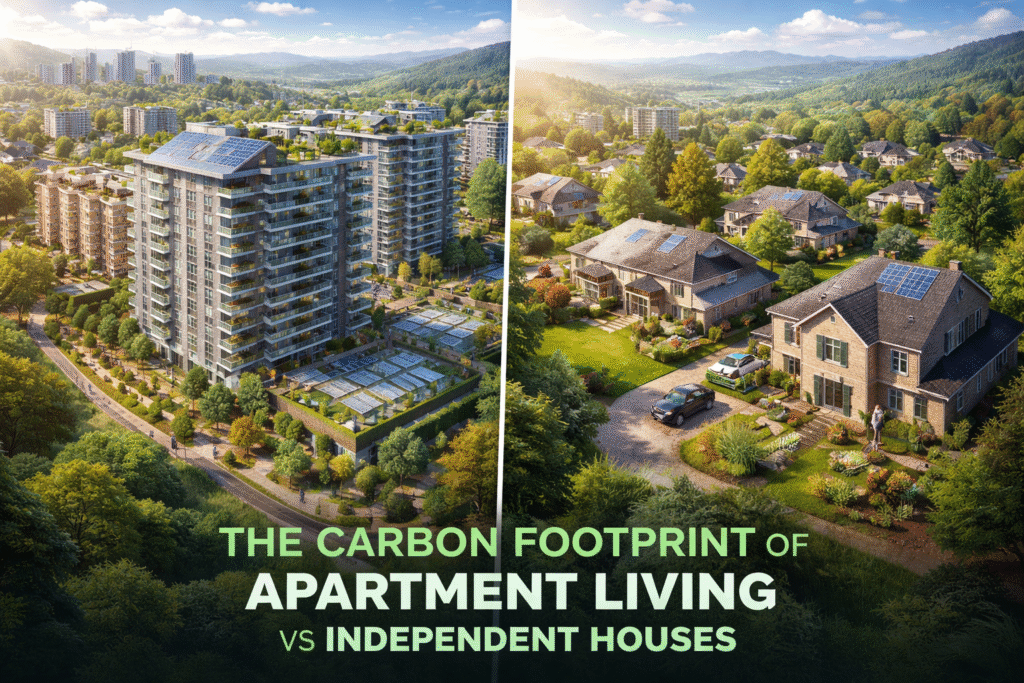
As cities expand and climate concerns grow louder, the way we choose to live matters more than ever. Housing is no longer just about comfort or status; it is also about responsibility. Every home—whether a high-rise apartment or a standalone house—leaves a carbon footprint. The real question is: which lifestyle treads more lightly on the planet?
While both options have environmental costs, their impacts differ in ways many people rarely consider. From construction materials to daily energy use, the comparison reveals some surprising truths.
Understanding Carbon Footprint in Housing
A home’s carbon footprint includes all greenhouse gas emissions produced during its construction, operation, and maintenance. This covers everything from cement production and electricity use to water consumption and waste management. Over decades, these emissions accumulate, making housing one of the largest contributors to global carbon output.
However, not all homes generate emissions equally. Density, shared resources, and infrastructure efficiency play major roles in determining environmental impact.
Construction: Shared Walls vs Sprawling Foundations
Construction is one of the most carbon-intensive phases of any building’s life cycle. Independent houses usually require more land, more materials, and more infrastructure per family. Each house needs its own foundation, roof, walls, plumbing, and electrical systems. This repetition multiplies the carbon cost.
Apartments, on the other hand, benefit from shared structural elements. A single foundation supports multiple households. Walls, ceilings, and floors are often shared, reducing the total amount of concrete, steel, and wood used per unit. Although high-rise buildings use significant materials upfront, their per-home carbon footprint is often lower when spread across dozens or hundreds of residents.
In dense urban areas, this efficiency becomes even more pronounced.
Energy Use: Efficiency in Numbers
Energy consumption is where apartments often gain a clear advantage. Shared walls reduce heat loss and gain, meaning apartments typically require less energy for heating and cooling. Units located between other homes stay naturally insulated, cutting down electricity use.
Independent houses, especially detached ones, are exposed on all sides. This exposure increases dependence on air conditioning, heaters, and ventilation systems. Larger square footage further raises energy demands, especially when cooling multiple rooms that are not always in use.
Additionally, apartment complexes often adopt centralized systems such as shared water heaters, solar panels, or energy-efficient elevators. These systems operate more efficiently at scale, lowering emissions per household.
Water Consumption and Waste Management
Water usage also tells an important story. Apartments generally rely on centralized water supply systems, making it easier to monitor leaks, install water-saving fixtures, and implement rainwater harvesting. Wastewater treatment is often more organized, reducing environmental leakage.
Independent houses, especially in suburban or semi-urban areas, may use private water pumps, overhead tanks, and septic systems. These setups can lead to higher water wastage and energy consumption, particularly where groundwater extraction is involved.
Waste management works similarly. Apartment complexes usually have organized waste collection, recycling programs, and shared composting systems. In contrast, individual houses may lack consistent recycling practices, increasing landfill contributions.
Land Use and Urban Sprawl
One of the most significant environmental differences lies in land use. Independent houses require more land per family, often contributing to urban sprawl. As cities spread outward, forests, wetlands, and agricultural land disappear. This loss reduces natural carbon sinks that help absorb greenhouse gases.
Apartments support vertical living, allowing more people to live within smaller land footprints. This density preserves green spaces and reduces the need for long roads, pipelines, and power lines. Less infrastructure expansion means fewer emissions overall.
Moreover, compact cities encourage walking, cycling, and public transport—further lowering transportation-related carbon emissions.
Transportation: The Hidden Carbon Cost
Where you live influences how you move. Apartment buildings are usually located closer to workplaces, schools, hospitals, and public transport hubs. Shorter commutes mean lower fuel consumption and fewer emissions.
Independent houses are often built farther from city centers, increasing reliance on private vehicles. Daily commutes, school runs, and errands add up quickly, making transportation one of the largest carbon contributors for detached homes.
In this sense, housing type indirectly shapes lifestyle emissions.
Maintenance and Renovation Over Time
Long-term maintenance also affects carbon footprint. Independent houses require individual repairs, repainting, roofing, and renovations, each involving material production and transportation emissions.
Apartments share maintenance responsibilities. Large-scale repairs often use fewer resources per unit and last longer due to professional management. Energy-efficient upgrades—such as LED lighting, insulation improvements, or solar installations—are also easier to implement collectively.
This shared approach reduces repeated environmental costs over time.
Are Apartments Always the Greener Choice?
While apartments generally have a lower per-capita carbon footprint, the answer is not absolute. Poorly designed buildings with inefficient materials, inadequate ventilation, or outdated systems can still consume excessive energy. Similarly, eco-conscious independent houses equipped with solar panels, rainwater harvesting, natural lighting, and green materials can outperform conventional apartments.
Lifestyle choices matter just as much as structure. Energy habits, waste segregation, and water use ultimately determine a home’s environmental impact.
The Bigger Picture: Sustainable Urban Living
As urban populations grow, cities face the challenge of housing millions without accelerating climate change. Apartments offer a scalable solution by combining density with efficiency. When designed thoughtfully, they reduce per-person emissions while supporting modern living.
Independent houses will always have their place, especially in rural settings. However, in cities, their environmental cost becomes harder to justify at scale.
Final Thoughts
The debate between apartment living and independent houses is not about right or wrong—it is about impact. On average, apartments produce a smaller carbon footprint per household, thanks to shared resources, reduced land use, and improved energy efficiency. Independent houses, while offering privacy and space, often carry higher environmental costs due to construction, energy use, and transportation needs.
As climate awareness grows, housing decisions are becoming climate decisions. Choosing where and how we live may be one of the most powerful ways to reduce our personal carbon footprint—one home at a time.